
WELCOME TO RUFFER

All-weather investing

Seeking consistent positive returns.

Come rain or shine.

Ruffer provides investment management services for institutions, pension funds, charities, financial planners and individual investors.
Location
Select your Location
Visitor Type
Select investor type
London
Ruffer LLP
80 Victoria Street
London SW1E 5JL
Paris
Ruffer S.A.
103 boulevard Haussmann
75008 Paris, France
New York
Ruffer LLC
300 Park Avenue
New York NY 10022
Edinburgh
Ruffer LLP
31 Charlotte Square
Edinburgh EH2 4ET

Grain expectations

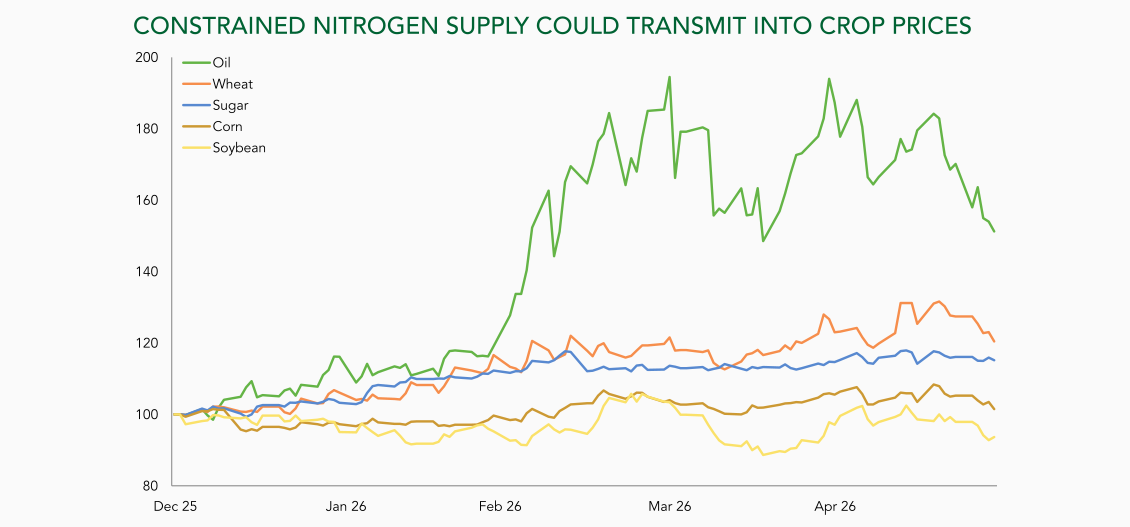
The oil price has reflected the geopolitical shock; agricultural prices have not yet
Line chart titled ‘Constrained nitrogen supply could transmit into crop prices’ showing prices for oil, wheat, sugar, corn, and soybean from December 2025 to April 2026, with oil rising highest and others gradually increasing.
Jasmine Yeo
Fund Manager

Markets have been quick to price geopolitical risk where it is most visible. The reaction in energy has been immediate and forceful. In food markets, however, the same shock is being treated as temporary – creating an opportunity for investors to add a different flavour of geopolitical hedge to portfolios. 

This month’s chart compares the recent performance of oil with a range of key agricultural commodities, each rebased to the end of last year. The divergence is clear: Brent crude is trading around 30% higher than on the eve of the conflict with Iran, whilst crop prices have lagged.

Yet the closure of the Strait of Hormuz has removed a meaningful share of globally traded fertiliser feedstocks, including urea (35%), ammonia (27%), phosphate (22%) and sulphur (45%).1 This matters because these feedstocks sit upstream of the entire crop system – quietly determining acreage decisions, yields and ultimately food prices.

Urea and ammonia are the primary traded forms of nitrogen fertiliser, a critical input for corn and wheat that directly influences yield potential and planting decisions. Higher fertiliser costs squeeze farmers’ margins, encouraging them to use less fertiliser or reduce the planted area, which can in turn feed through into higher grain prices. Sugar and soybeans are less exposed to this dynamic. But they are used in biofuel production – sugar for ethanol and soybeans for biodiesel – meaning they can benefit indirectly as higher oil prices incentivise substitution. 

Pause icon
0.00
0:00
Volume icon
CC
Fullscreen icon
Play icon

So why has there been such a muted price reaction? 

Agriculture runs on a calendar, not a news cycle. Northern Hemisphere spring planting largely used inventory purchased before tensions escalated. However, the next purchasing window occurs in the Southern Hemisphere and begins over the summer. This is when farmers will return to the market for nitrogen inputs. If the Strait remains closed into that period, today’s logistical constraint becomes tomorrow’s economic pain.

This is why the market appears complacent. It is not ignoring the problem – it is assuming the problem goes away. A resolution between the US and Iran is the consensus view and, until that assumption is challenged, the market does not have to deal with the consequences. If the disruption fades quickly, the market’s current indifference will be justified. But, if it persists a little longer, the transmission into crop economics becomes hard to ignore – making agricultural commodities a potentially asymmetric hedge.

In addition, agricultural commodities typically perform well in periods of high and rising inflation, delivering positive real returns in most historical inflationary episodes. In portfolio terms, Ruffer’s 2% exposure to these commodities complements existing inflation and geopolitical hedges, whilst adding diversification through assets driven by different forces – from logistics to weather.

There is one important wild card. China has been restricting urea exports since the end of last year, building up inventory in the process. A decision to re-enter the market at scale could ease supply concerns before the summer planting period. Equally, a resolution to the conflict and a full reopening of the Strait would allow delayed (rather than lost) supply to return quickly as shipping normalises. Finally, agricultural markets remain inherently sensitive to weather and seasonal dynamics, which can amplify or offset the fertiliser shock. The likely return of El Niño into 2026 only reinforces that, with past events associated with meaningful disruption to agricultural output.

At Ruffer, we do not aim to predict how the conflict will evolve from here. We look to own assets that protect the portfolio against unfavourable outcomes. Agricultural exposure offers an unusually asymmetric way of doing that: a hedge that could respond if tensions persist or re escalate, but which starts from a far less demanding base than oil.

Jasmine Yeo
Fund Manager
GET IN TOUCH
Piers Wheeler
Director – Institutional
Developing and executing asset management strategy for capital raising and strategic relationship management. Coverage includes EMEA, Asia and Australia. Piers joined Ruffer in 2021, having previously worked with asset management firms including Eastspring, AMP Capital and LEK as a strategic consultant. He holds a MA from the Bayes Business School and a BA (Hons) from the University of Oxford.
Annabel Paterson
Annabel Paterson
Senior Associate – Institutional
Joined Ruffer in 2021, having graduated with a first class honours degree in land economics from the University of Cambridge. After two years working with the UK Private Wealth team and completing her IMC and CFA Level I qualifications, she now supports Ruffer’s global business development and client servicing efforts.

Chart source: Bloomberg, data as at May 2026

1 Morgan Stanley. Figures represent percentage of traded supply. Estimate traded supply to be 40-45% of total supply. 

The views expressed in this article are not intended as an offer or solicitation for the purchase or sale of any investment or financial instrument, including interests in any of Ruffer’s funds. The information contained in the article is fact based and does not constitute investment research, investment advice or a personal recommendation, and should not be used as the basis for any investment decision. References to specific securities are included for the purposes of illustration only and should not be construed as a recommendation to buy or sell these securities. This article does not take account of any potential investor’s investment objectives, particular needs or financial situation. This article reflects Ruffer’s opinions at the date of publication only, the opinions are subject to change without notice and Ruffer shall bear no responsibility for the opinions offered.

This financial communication is issued by Ruffer LLP which is authorised and regulated by the Financial Conduct Authority in the UK and is registered as an investment adviser with the US Securities and Exchange Commission (SEC). Registration with the SEC does not imply a certain level of skill or training. © Ruffer LLP 2026. Registered in England with partnership No OC305288. 80 Victoria Street, London SW1E 5JL. For US institutional investors: securities offered through Ruffer LLC, Member FINRA. Ruffer LLC is doing business as Ruffer North America LLC in New York. Read the full disclaimer

Narratives and the shifting market mindset
Stories are increasingly driving markets, outweighing the fundamentals. We analyse how this dynamic works – and how to avoid getting caught in the downdraft.
Read
Shadow banking: the next financial crisis?
Guest contributor Ben Hunt looks at the mechanics of the current boom in private credit and explains why he thinks it may end in a major bust.
Read
The road to prosperity is paved with debt
While many investors are focused on high public-sector debt levels, few appreciate how increased new borrowing by the private sector could spur GDP growth and support asset prices.
Read
London
Ruffer LLP
80 Victoria Street
London SW1E 5JL
Paris
Ruffer S.A.
103 boulevard Haussmann
75008 Paris, France
New York
Ruffer LLC
300 Park Avenue
New York NY 10022
Edinburgh
Ruffer LLP
31 Charlotte Square
Edinburgh EH2 4ET