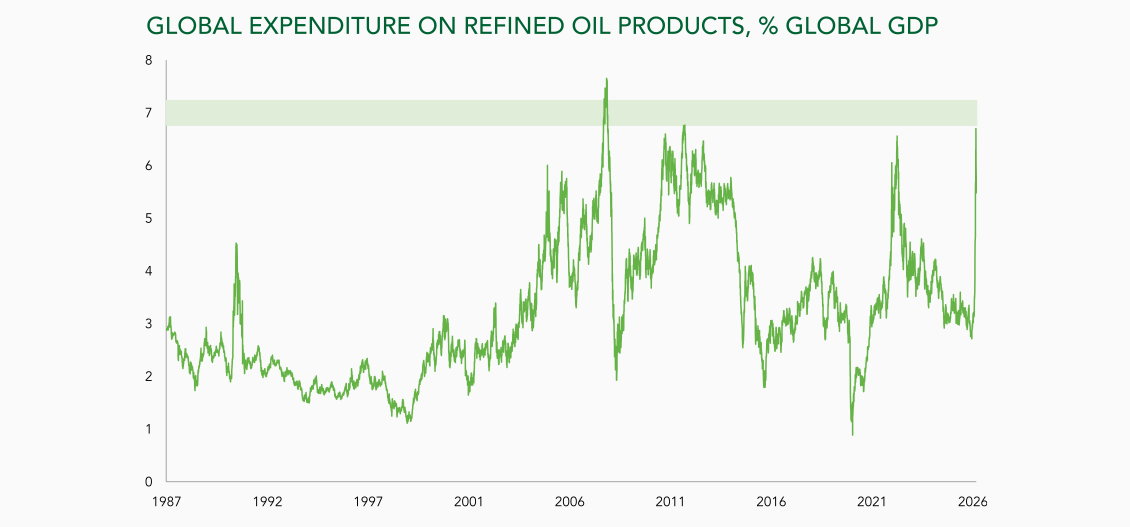



China, Japan and South Korea stand out among major manufacturers for their reliance on energy imports from the Middle East and the relatively large size of energy-intensive sectors, though they also hold considerable stockpiles of fossil fuels. The UK is less exposed: it imports nearly no oil and gas from the Middle East, economic activity is skewed towards services, and households spend a lower share of their income on food and energy. By contrast, the US has, since its shale revolution, become the largest oil producer in the world and is roughly self-sufficient for its energy needs. It therefore emerges as a relative winner.
Central bankers face difficult trade-offs. On the one hand, the recency of the 2022 inflationary episode and several years of above-target inflation mean wage and price setting behaviour may be more significantly impacted by a second wave, potentially leading to a broadening out of the inflationary shock.
On the other hand, at the time of Russia’s invasion of Ukraine, the global economy was recovering from the pandemic: most developed economies’ labour markets were considerably tighter, their aggregate demand stronger and their governments’ fiscal stance more expansionary than today. In fact, large fiscal stimuli likely played an essential role in further fuelling inflation amid the 2022 energy crisis.
Nowhere are these differences starker than in the UK. A weak labour market, muted consumer and business confidence and constrained fiscal space mean risks today are skewed towards sluggish economic activity, rather than sustained inflationary momentum. Whether a prolonged oil shock causes an economic slowdown, or a swift resolution leads to a normalisation of energy prices, we think the bar to policy rate hikes is high. So, when the Bank of England struck a hawkish note at its March meeting and markets reached for their 2022 playbook, we saw the upward move in market interest rates as an opportunity to tactically allocate to medium-term (five year) UK gilts. This is an example of our ongoing evaluation of the opportunity set (alongside protection) amidst market volatility.
Looking over the horizon, the painful supply side shock central banks now have to contend with is an uncomfortable reminder of our changed world. At Ruffer, we have long expressed our view the ‘deflation machine’ era is being replaced by a new economic and market regime that is both more inflationary and more volatile. Geopolitical disruption and more frequent supply shocks are part of the unpredictable consequences of the demise of America’s hegemonic world order, accelerated by Trump’s return to the White House. In this new regime, inflation volatility is a feature, not a bug.


