
Valuing volatility

Low equity market volatility at the index level hides trouble beneath the surface
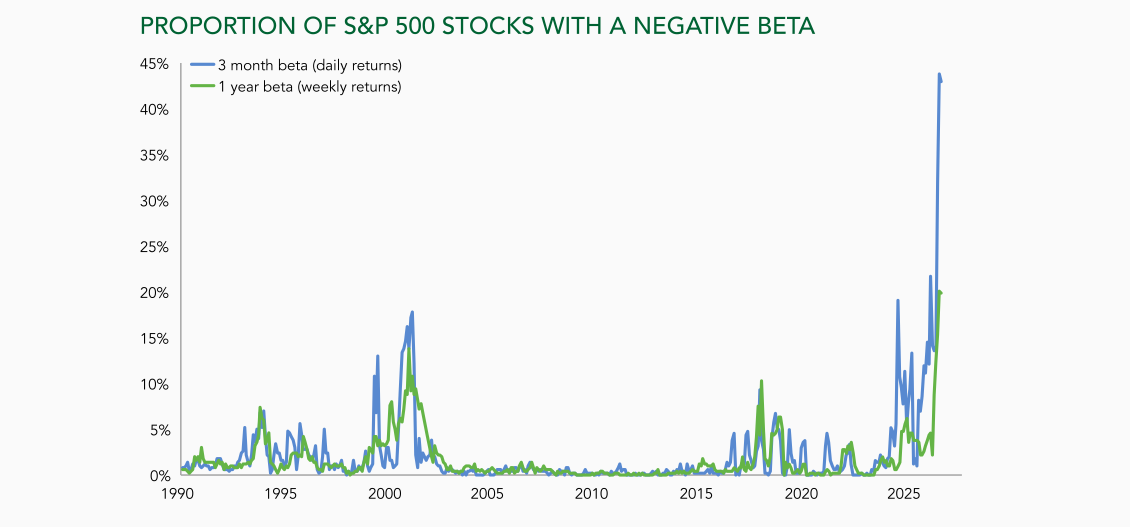
Line chart titled 'Proportion of S&P 500 stocks with a negative beta' showing data from 1990 to 2027. Blue and green lines track 3‑month and 1‑year beta measures, with major spikes around 2000, 2020, and 2026–27.
Nicole Wardle
Manager – Private Wealth

On the surface, the US equity market looks remarkably calm. The CBOE Volatility Index (VIX), a measure of expected near-term price volatility for large US stocks, is at a low level, suggesting investors are not expecting the sharp price changes symptomatic of a market sell-off.

If you look under the bonnet, however, something strange is going on. This month's chart shows a sharp move in one component of index volatility for the US market - the correlation of the underlying stocks to the index as a whole. It reveals an increase in the proportion of stocks in the S&P 500 which have been moving in the opposite direction to the index. That means, whilst the market as a whole has been rising, a large proportion of individual stocks have been falling. Consequently, 2026 is on track to be the least correlated year on record for stocks. The last time we saw similar levels was just before the bursting of the dot-com bubble in the early 2000s.
Pause icon
0.00
0:00
Volume icon
CC
Fullscreen icon
Play icon

When correlation is low, it mechanically holds down index level volatility, even when prices of single stocks are moving sharply. Stock price moves are pulling in different directions and to some extent cancelling each other out.

If today's level of single stock volatility was combined with a historically average correlation between individual stocks and the index, the VIX would be over 30. The 'fear gauge' at those levels has more typically been associated with significant investor unease and is well above the average level so far in 2026 of just 18. Rising correlation usually happens during a market sell-off, when investors want to sell stocks across the board.

There are a number of potential drivers of the recent low correlation. One is the extraordinary concentration of the US stock market. A small number of mega-cap technology companies have generated an unusually large share of index performance. Their fortunes are increasingly tied to the enormous investment cycle around AI. The divide between those the market has judged to be AI winners and losers has echoes of dot-com, when internet stocks surged, to the detriment of other sectors, as investors expected the new technology to cause significant disruption. Although high levels of market concentration are not unusual, when the performance of these high-flying stocks is driven by the same story, any wobble in the positive AI narrative could have a serious impact.

However, this low correlation is not just a difference between technology and non-technology stocks. Correlations are also low between stocks within sectors. Investors have been picking their expected winners and losers of the AI story, and all of this has been forcing index volatility lower. Another driver is the growth of long/short equity funds, a popular hedge fund strategy where traders own one stock and sell another against it, benefiting if prices move their way. Hedge fund capital saw its largest quarterly increase in history in the second quarter of this year, reaching a total of $5.6 trillion, and 2025 was the strongest calendar year for hedge fund investor inflows since 2007. These trades have been contributing to single stock volatility while having little impact at the headline level.

A market where a higher proportion of stocks are moving against the index may appear unsettled, but it also offers opportunities. Today, value can be found in opportunities which have been overlooked in favour of the AI trade. The growth element of the Ruffer portfolio aims to take advantage of this, looking for companies that should benefit in a benign market environment if the narrow focus on AI stocks broadens out.

In a sell-off, the Ruffer portfolio should see gains from its protective assets, including VIX call options, derivatives which make money when index level volatility rises. Low correlations have given us an opportunity to buy this defensive protection at attractive prices, with a strong potential payoff if correlation and index level volatility rise.

Nicole Wardle
Manager – Private Wealth
GET IN TOUCH
Piers Wheeler
Director – Institutional
Developing and executing asset management strategy for capital raising and strategic relationship management. Coverage includes EMEA, Asia and Australia. Piers joined Ruffer in 2021, having previously worked with asset management firms including Eastspring, AMP Capital and LEK as a strategic consultant. He holds a MA from the Bayes Business School and a BA (Hons) from the University of Oxford.
Annabel Paterson
Annabel Paterson
Senior Associate – Institutional
Joined Ruffer in 2021, having graduated with a first class honours degree in land economics from the University of Cambridge. After two years working with the UK Private Wealth team, she now supports Ruffer’s global business development and client servicing efforts. She is a CFA charterholder.

Chart source: Data Stream, Goldman Sachs Global Investment Research 

The views expressed in this article are not intended as an offer or solicitation for the purchase or sale of any investment or financial instrument, including interests in any of Ruffer’s funds. The information contained in the article is fact based and does not constitute investment research, investment advice or a personal recommendation, and should not be used as the basis for any investment decision. References to specific securities are included for the purposes of illustration only and should not be construed as a recommendation to buy or sell these securities. This article does not take account of any potential investor’s investment objectives, particular needs or financial situation. This article reflects Ruffer’s opinions at the date of publication only, the opinions are subject to change without notice and Ruffer shall bear no responsibility for the opinions offered.

This financial communication is issued by Ruffer LLP which is authorised and regulated by the Financial Conduct Authority in the UK and is registered as an investment adviser with the US Securities and Exchange Commission (SEC). Registration with the SEC does not imply a certain level of skill or training. © Ruffer LLP 2026. Registered in England with partnership No OC305288. 80 Victoria Street, London SW1E 5JL. For US institutional investors: securities offered through Ruffer LLC, Member FINRA. Ruffer LLC is doing business as Ruffer North America LLC in New York. Read the full disclaimer

Six mindsets for greatness
Guest contributor Jake Humphrey talks about Game Plan, which uses lessons from his High Performance Podcast to teach young people the secrets behind high achievers’ success.
Read
Crude awakenings
The shale revolution transformed US oil and gas output, profoundly altering the global energy balance. If the shale boom is now over, that will have enormous geopolitical and economic consequences.
Read
Shadow banking: the next financial crisis?
Guest contributor Ben Hunt looks at the mechanics of the current boom in private credit and explains why he thinks it may end in a major bust.
Read
London
Ruffer LLP
80 Victoria Street
London SW1E 5JL
Paris
Ruffer S.A.
103 boulevard Haussmann
75008 Paris, France
New York
Ruffer LLC
300 Park Avenue
New York NY 10022
Edinburgh
Ruffer LLP
31 Charlotte Square
Edinburgh EH2 4ET