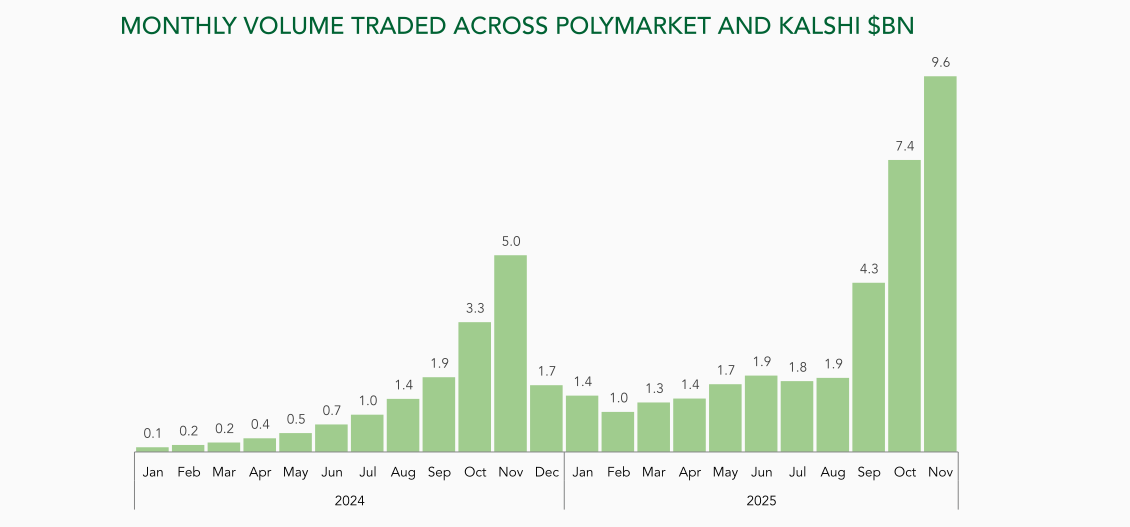



Proponents champion these markets as innovative tools for hedging and information discovery, or ‘truth-seeking’. Investors can use these platforms to insure themselves against the outcome of real-world events. By requiring users to put skin in the game, they harness the ‘wisdom of crowds’, transparently generating a collective forecast. Indeed, their success in predicting certain high profile events such as elections may well indicate an accurate reflection of public sentiment.
Their usefulness has not gone unnoticed, and their integration with traditional finance is accelerating. In partnership with Kalshi, Robinhood has launched a prediction market within its existing brokerage app. Google has announced plans to integrate prediction odds into its finance platform. Even the Intercontinental Exchange, parent company to the NYSE, has announced plans to invest $2 billion in Polymarket, valuing the company at $8 billion. These endorsements reflect growing recognition that this crowd-sourced information can provide a valuable signal.
Yet these innovations arguably represent another step in the ‘gamification’ of finance. The contracts appear to have much in common with gambling, particularly on sports. The structures encourage users to view markets as venues for instant gratification, as prices become increasingly divorced from fundamental value.
The philosopher Nick Land coined the term hyperstition, where collective belief (or hype) acts as a self-fulfilling prophecy. In this way, betting on single outcomes might build expectations which feed momentum and lead to action. Could major prediction contracts ultimately influence market prices, investor behaviour or even public perception and policy? Furthermore, these odds can be swayed by sufficient capital, and there are few guardrails in place against opaque insider manipulation. So called ‘whales’ have been known to place large, market moving bets, winning many millions on events such as the US election.
At Ruffer, we have spoken about the risks of reflexivity in markets, where price becomes a narrative itself, driving fundamentals. It is a dynamic amplified by algorithmic trading, volatility targeting and now perhaps real-time measures of public belief. In our portfolios, we seek truly uncorrelated assets that can protect against the unravelling of these reflexes. All in, prediction markets are yet another innovation making the financial system look more like a high stakes casino.


