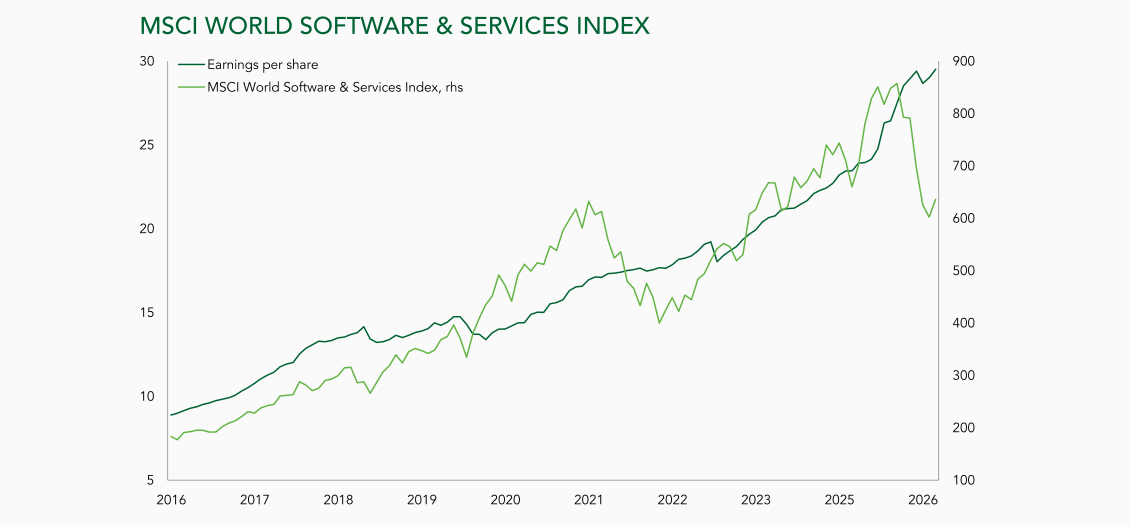



Since last October, the global software and services sector has fallen by more than 25%. We have had limited exposure, reflecting our tendency to be wary of elevated multiples – particularly in industries where share based compensation is rife and can dilute shareholder returns. However, the scale of the recent sector derating (from 34x to 22x) piques our interest as contrarian investors.
The core challenge is that the bear case cannot be disproved. AI is expected to materially change the enterprise software landscape. But uncertainty often creates opportunity. And we believe the market may be under-appreciating some of these companies’ resilience.
The value of enterprise software extends well beyond writing code. Providers deliver security and data protection, regulatory compliance, system reliability and maintenance. These functions are critical, and most organisations do not want to take on the responsibility in-house. We see application software as a natural layer through which AI could be meaningfully deployed at scale. Software incumbents with established user bases are well positioned to integrate AI capabilities into existing products, potentially enhancing rather than undermining their value.
Selling software into enterprises requires trusted relationships and established distribution channels. New entrants face a significant challenge in building both. Recent reports that OpenAI plans to materially expand its workforce may be indicative of these barriers. Scaling enterprise adoption requires not only technological capability, but also sales infrastructure, customer support, regulatory expertise and a deep understanding of customer workflows. (Did someone whisper ‘moat’?)
We have initiated a small position in a basket of software companies as an expression of contrarian value. We think established companies with strong brands and market positions supported by deep distribution networks may prove more resilient than the market is currently pricing. To minimise credit risk, we select companies with strong balance sheets and cash flow, while the portfolio holds a large position in US investment grade credit spreads and stands to benefit should concerns intensify.
AI undoubtedly represents a powerful and disruptive force. The software and services sector is likely to experience a period of elevated uncertainty, marked by both innovation and competition. However, the recent price action appears to reflect a pessimistic outcome. In some cases, we think this is unjustified. We cannot definitively say what the enterprise software landscape will look like in five years’ time. But we can identify companies with the balance sheet strength, competitive positioning and strategic flexibility to help them navigate the transition.


