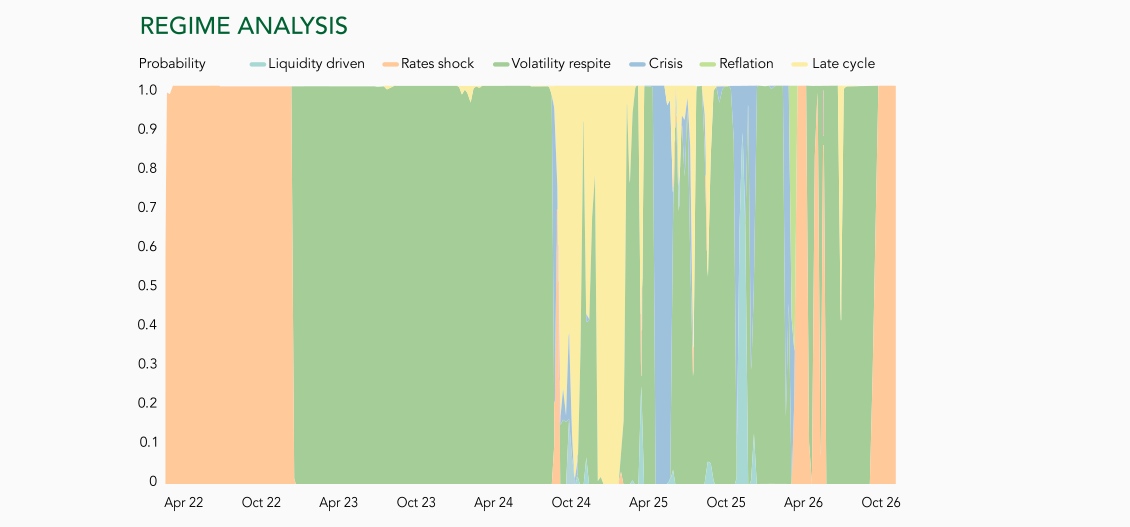




For much of 2023 and 2024, markets enjoyed a volatility respite regime (shown in green on the chart), characterised by relative calm and buoyant asset prices. Since the end of 2024, however, the market has moved between regimes with unusual frequency, pointing to a less stable underlying environment.
That instability became particularly visible in the final ten days of September 2026, when the US 10-year Treasury yield rose rapidly from 5.0% to 5.3%. The model’s corresponding shift from green to orange (rates shock regime) indicated that the sell-off in bonds had spread to other asset classes. We started to see signs of this in credit as spreads moved from c 50 to 60 by month end. In this more challenging regime, higher yields and greater interest rate volatility can unsettle investors, weigh on valuations and disrupt the usual relationships between assets.
But what happens next?
The most likely outcome: markets remain in the rates shock regime. Under the hood, the model suggests that regimes tend to persist, sometimes for extended periods, as they did during 2022 and around the bursting of the dot.com bubble.
Importantly, if markets leave the rates shock regime, the model suggests they will probably enter one of two very different regimes –
a) Volatility respite – yields stabilise, interest rate volatility falls and September’s monsters prove less threatening than they first appeared
b) Crisis – stress spreads beyond the bond market, triggering a broader sell-off across equities and credit
Based on historic patterns, if the current regime changes, a crisis is the highest probability. But we have positioned the portfolio with both paths in mind.
If calmer conditions return, the portfolio’s approximately 40% allocation to equities and commodities should benefit. We used September’s higher yields to double the portfolio’s duration (sensitivity to changes in interest rates) from around two years to four. In simple terms, a one percentage point fall in yields could now add roughly 4% to portfolio returns, compared with around 2% previously. As yields fell during October, this additional duration contributed positively, illustrating how government bonds could benefit if the rates shock gives way to a volatility respite regime.
Duration could also provide protection if the rates shock regime develops into a deflationary crisis. If tighter financial conditions or mounting concerns about AI capex trigger a market sell-off, yields could fall as equities decline.
But not every crisis is deflationary. In a more inflationary world, equities and bonds can fall together, as they did in 2022. If yields resume their rise and destabilise equities and corporate credit, the portfolio’s credit protection, S&P 500 put options and volatility call options are designed to provide a direct defence.
The model cannot tell us exactly what comes next, but it can help us to identify how the market environment and balance of risks are changing. We combine that signal with our qualitative judgement to construct a portfolio that can respond to different outcomes, rather than relying on a single forecast. Markets may appear to be moving out of the woods, but they are not necessarily in the clear. Our task is to help ensure the portfolio is prepared for whichever path they take next.


